top of page

Research Blog

Search
  • Writer: Padmanabh Joshi
    Padmanabh Joshi
  • Aug 11, 2022
  • 2 min read

By Padmanabh Joshi


Imagine a scenario where one morning, a close friend of yours calls you and painfully conveys the news of him being diagnosed with cancer and you, instead of sitting horrified and helpless, casually say “Hey don’t worry man, we have PDT!” That sounds fascinating right?! Yes, Photodynamic therapy has shown potential to do that. With the same fascination towards the idea of photodynamic therapy, inventors of PDT pursued research on this therapy and shaped an unconventional out of box method of treating cancer. The simple mechanism of working of this technique is widely known. Drugs used in this technique are light sensitive. In response to specific light irradiated on the drug molecule, it converts surrounding molecular oxygen into form of oxygen which kills nearby cancer cells. The reasons this therapy called as out of box here are multifold. First, there are many photosensitizers easily available approved by FDA which can easily respond to specific light and produced the effect explained above. Second it makes use of naturally available oxygen molecules surrounding cancer cells. Last and importantly all the conventional drugs/ therapies for the cancer are immunosuppressive meaning they suppress our immune system after treatment unlike PDT, which is immunostimulative which stimulates immune system of the patient after treatment.


Proving very promising in its early years of research, PDT faces a major challenge. Light sensitive drugs usually respond to visible light. Visible light’s penetration in the tissues and cells is poor because it is mostly absorbed and hence the drug does not get sufficient light to tackle cancer cells (This is the low penetration depth of visible light). This is a major bottleneck in PDT’s usage and is being addressed by researchers all over the globe.
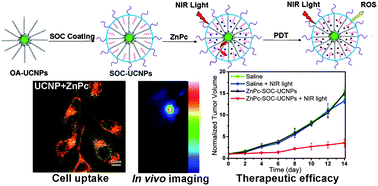


In one very fine effort by Sisi Cui etal they try to address the problem stated above in very interesting way. The key fact they have exploited here is though visible light’s penetration in the tissue and biological matter is weak but near infer red (NIR) light can penetrate deeply in the same tissue without any problem. So NIR light can be good alternative to visible light. Here Sisi Cui etal synthesized NaYF4(Er,Yb) nanoparticles ( upconversion nanoparticles) which can convert NIR light to visible light. A chitosan derivative (biocompatible polymer) has coated these nanoparticles with drugs deposited on their surface. So upconversion nanoparticles and light sensitive drug are in close proximity of each other. So when NIR light is irradiated, upcoversion nanoparticles convert that light in visible light( drug is essentially insensitive to NIR light) and transfers that light to the drug which in response coverts surrounding oxygen from the molecular form to the form which can kill the cancer cells. This study which is cited below has not only addressed the problems associated with the synthesis of hydrophilic NaYF4 nanoparticles brilliantly, but also shown that the scheme they have proposed works successfully which they have demonstrated actually by killing in vitro cancer cells.

Amphiphilic chitosan modified upconversion nanoparticles for in vivo photodynamic therapy induced by near-infrared light Sisi Cui, Haiyan Chen, Hongyan Zhu, Junmei Tian, Xuemei Chi, Zhiya Qian, Samuel Achilefu and Yueqing Gu J. Mater. Chem. C, 2012, 22, 4861-4873. DOI:10.1039/C2JM16112E

  • Writer: Padmanabh Joshi
    Padmanabh Joshi
  • Aug 5, 2022
  • 2 min read

Updated: Aug 11, 2022

By Padmanabh Joshi


As summer is kicking off, glimpses of the sun lovers basking with their headphones and sunglasses on, on beaches or in other pleasant places is not rare. Imagine you are one of them. You happen to be on one the wonderful beaches, basking, listening to your favorite playlist on your mp3 player. You are having delightful time and suddenly you hear an intimidating beep notifying you that it is out of battery jeopardizing your divine moment. What will you do? Will you continue basking disappointed or take off your glasses and use them for charging your mp3 player? Yes! You read it right, sunglasses can be actually made to charge your mp3 player or your phone for that matter! Self-energy converting sunglasses based on a dye sensitized solar cell (DSSC) present this opportunity. Not limited to glasses, DSSC technology can make skylights, windows, even building facades (which are exposed daylight) capable of producing electricity. This third generation solar cell can be likened to artificial photosynthesis due to the way in which it mimics natures’ absorption of light energy. According to researchers in this field this is the closest we have been to photosynthesis. This new generation of solar cells are greener, smaller, more flexible and inexpensive as compared to the early generation solar cells. These advantages are due to the usage of dye as photosensitive material which also makes the working mechanism simple. Dye molecules respond to light by transferring electrons to the titanium dioxide layer which helps in the movement of electrons constructing current. The circuit is completed by the electrolyte present in the cell transferring the electrons back to the dye.


Although this DSSC technology has produced a record efficiency of 11% conversion of solar energy to electrical energy, researchers all over the globe are trying to elevate the efficiency of the system by synthesizing and incorporating new dyes with different structures and functional groups with electron donating capacity.


Generally dye used in DSST consists of electron donor, linker and electron acceptor moieties connected to each other. In a very fine effort to optimize the structure of the dye, Zhongquan Wan, Chunyang Jia etal, cited below, investigated effect of different linker moieties in the dye structure on the efficiency and overall working of the solar cell. The 3 different linker moieties investigated were benzene, thiophene and furan. They not only successfully synthesized dyes with different linker moieties but also calculated the working efficiency and performance of the cell. They reported that furan as linker moiety works best as compared to other 2 linkers. Also they successfully reported synthesis of star-burst shaped dyes which reduces aggregation between the dye molecules giving rise to better performance of the cell. This high impact study will certainly contribute to make this green DSSC technology more efficient and hence commercialized.

Zhongquan Wan, Chunyang Jia, Yandong Duan, Linlei Zhou, Yuan Lin and Yu Shi


J. Mater. Chem., 2012, 22, 25140-25147 DOI: 10.1039/C2JM34682F

Updated: Aug 11, 2022

By Padmanabh Joshi


“What? Why? How?” All kinds of “wh” questions I bombarded at my buddy Marc when he apprised me that he is not going to make it to the long awaited trip. “Somebody tried to poison me” followed by guffaw was the jocular repartee from Marc. After a demented pause from my side, Marc cleared the air of confusion and sickeningly reported that he is suffering from food poisoning. The next morning I drove down to his place to see how he is doing. In one of the friendly banters which we always indulge into, he said” Non sense, this food poisoning man, I wish I could have some device like a phone which can detect the contaminants in food right away, so that I can make store owner eat that food once I find it’s contaminated” followed by burst of laughter. “Typical Marc” I muttered with smirk. But on my way back home that ‘device’ thought of Marc’s stuck in my head and being a chemist I started screening all the techniques used for the detecting chemicals and asked myself which technique can be exploited to make such a handy device to detect chemical contaminants. The answer came without a waste of second, its Surface Enhanced Raman Scattering(SERS)!


SERS is a result of the interaction of light(electromagnetic radiations) with the chemicals on nanostructured (of the size of nanometers) metal surface like silver and gold. Depending upon the composition and structure of the chemical, its interaction with the light is different. Interaction of light with chemical also depends on the metal nanosubstrate. After interaction with the light, interaction profile( spectrum) of light with chemical is generated. Every chemical has its own and unique interaction profile with light which can be called as fingerprint of that chemical. One can actually detect some unknown chemical just by interacting it with light and generate the interaction profile( fingerprint). Matching the profile with known chemicals, one can tell what chemical it is!


Though the phenomenon of SERS in well known, production of silver or gold nanostructure which can lead to very high interaction of light and chemical is not an easy task. Yan Zhou etal in one fine effort cited at very end have produced gold core silver shell nanoparticles with very high SERS activity. They have also examined the effect of thickness of the silver shell on SERS signals and developed a versatile SERS nanosubstrate. Method of synthesis of high quality gold core silver shell nanoparticles is very facile and structure can be maneuvered according to applications. Layer by layer approach of coating silver shell on gold core with Raman probe( chemical) inside is also reported here to have huge interaction between light and probe leading to high SERS activity.

Yan Zhou, Changwon Lee, Jinnan Zhang and Peng Zhang.

J. Mater. Chem. C, 2013,1, 3695-3699 DOI: 10.1039/C3TC30561A

2

Address
 
Room# 1205
French Family Science Center
124 Science Drive
Duke University
Durham, NC 27707

©2023 by Padmanabh Joshi Proudly created with Wix.com

Phone
(502)-936-2518

Email

padmanabh.b.joshi@gmail.com
 

  • Twitter
  • LinkedIn
google-scholar.png
bottom of page