top of page

Research Blog

Search

Updated: Aug 11, 2022

By Padmanabh Joshi


The audience at Arthur Ashe Arena at Flushing Meadows were on their feet with a huge round of applause after the scintillating first set of tennis between Shui Peng and Caroline Wosniacki at the US Open 2014, one of the biggest and most renowned stages for tennis championships. It was 82F(29 oC) out there with grueling conditions for playing. One of the finest tennis contests was being produced until suddenly Shui was struck by cramp in her left leg which is a symptom of many heat related illnesses. After 10 minutes of high drama in the presence of nearly 20000 tennis frenzied crowd, Shaui Peng had to retire after several futile attempts to pursue her quest for the US open title. Multiple events of this sort have prevailed in the history of the sports, also cases where athletes have withdrawn from competitions because of grueling weather forecasts are omnipresent . Being a sport enthusiast, I was forced to wonder, is it just temperature that is a culprit for heat illness or there is something else as a “partner in crime”?!


It turned out that not only temperature but an amalgamation of high temperatures with high humidity levels is what causes heat illness. It was 82F when Shuai had to to retire but more importantly the humidity level was an all time high 77%!


One might wonder what is up with this combo of high temperature and humidity levels? High humidity levels makes it seem hotter. For example according to heat index, temperature of 95 F feels like 95F when humidity level is 30%, but the same 95 F feels like whopping 125F when humidity level is 70%. To understand how this works, one needs to know the human body’s cool down mechanisms. Cooling mechanisms of the body operate through sweating, alteration in the rate of blood flow and increased respiration when outside temperatures become higher than the body’s temperature. If the relative humidity levels are high, the rate of evaporation of water from the skin is dampened and hence the cooling mechanism through sweating fails leading to an increase in the body temperature resulting in loss of nutrients and fatigue earlier than in normal conditions. This is when human body suffers from heat cramps, heat stroke and short heat illness. This is how relative humidity should also be blamed for heat illness along with temperature.
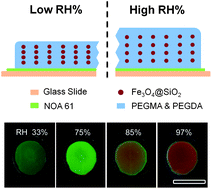


Facile detection of humidity levels is very crucial for taking proactive measure to avoid heat illness. Xuan et al in a very fine effort, develop a novel humidity sensor based on magnetically assembled photonic nanocrystal. This nanocrystal is sensitive to humidity levels and changes to different colours with different humidity levels as a response. The humidity level can be easily assessed just by looking at the nanocrystal’s color. This work which is cited below not only reports brilliant synthesis of nanocrystals for humidity detection but also investigates the effect of change in different parameters of nanocrystals on the sensitivity of the detection.

Ruyang Xuan, Qingsheng Wu, Yadong Yin and Jianping ge

J. Mater. Chem., 2011,21, 3672-3676

  • Writer: Padmanabh Joshi
    Padmanabh Joshi
  • Aug 5, 2022
  • 2 min read

Updated: Aug 11, 2022

By Padmanabh Joshi


“It’s cold and white everywhere. What else can you expect on early January’s very snowy evening!” I mumbled to myself and was heading towards home exhausted when I witnessed the almost ungovernable sliding inevitable collision of two nice looking vehicles with people on driving seats trying hard to salvage the situation. It was not a gratifying view for the spectators let alone for the vehicle owners and insurance companies (of course). Knowing that not much could be done from my side, I resumed my meticulous “frictionless” walk but this time pondering over the collisions.

In general as the scale (size) of the colliding bodies increases, the collision turns out to be more and more disastrous, collision of the bodies the scale of aircraft is unimaginably catastrophic with the scale of the damage shrinking with the scale of the colliding bodies. The thought which struck was, is there any collision which can be useful rather than damaging? Without wasting a second, I questioned myself with conquering smirk, how about collisions of molecular levels?! “They are awesome and intriguing!” was my first reaction. Yes, molecules of angstrom meter (10000 times smaller that human hair diameter) size collide with each other in solution. Not only do they collide with each other, they construct a multitude of stunning phenomena.


With this same collision, some class of substances give rise to the phenomenon of light upconversion (converting light from low energy to high energy). Typical upconversion systems consists of 2 dyes (highly light responsive substances). When light of particular energy (for example, green light) is irradiated on the system, one of the dyes (donor) is excited by the absorption of the light. 2 molecules of the donor dye collide and transfer their energy to 2 molecules of the other dye (acceptor) present in the system. A further 2 molecules of the acceptor dye collide with each other and emit colorful light (fluorescence) of a different colour (for example: blue, a higher energy). As light emitted from system is of a higher energy than the light provided to system, its called an upconversion system. Collision on a molecular level can do very fun things.

These kind of upconversion systems can have applications in solar cells and for that, a brief and detailed study of these kind of systems is necessary. Generally it is difficult to study these systems in the water phase because the dyes involved hate water. Chenquing etal successfully stabilized these systems in nanopockets of Tween 20 (surfactant) micelles in water. They also studied upconversion systems based on different kinds of acceptors and donors dyes. This study, which is cited at the end, not only correlates the structure of the dyes to the upconversion efficiency but also demonstrates effect of temperature on the amount of light drawn out of the system. Excellent efforts for exploiting this intriguing phenomenon in photochemistry (producing electricity using light emitted) are also illustrated. This study also claims to be the first study to provide clean upconversion without degassing.

Oil-in-water microemulsion: an effective mediumfor triplet–triplet annihilated upconversion withefficient triplet acceptors. Changqing Ye, Bao Wang, Roukang Hao, Xiaomei Wang, Ping Ding, Xutang Tao, Zhigang Chen, Zuoqin Lianga and Yuyang Zhoua J. Mater. Chem. C, 2014, Advance Article DOI: 10.1039/C4TC00791C

1

Address
 
Room# 1205
French Family Science Center
124 Science Drive
Duke University
Durham, NC 27707

©2023 by Padmanabh Joshi Proudly created with Wix.com

Phone
(502)-936-2518

Email

padmanabh.b.joshi@gmail.com
 

  • Twitter
  • LinkedIn
google-scholar.png
bottom of page